

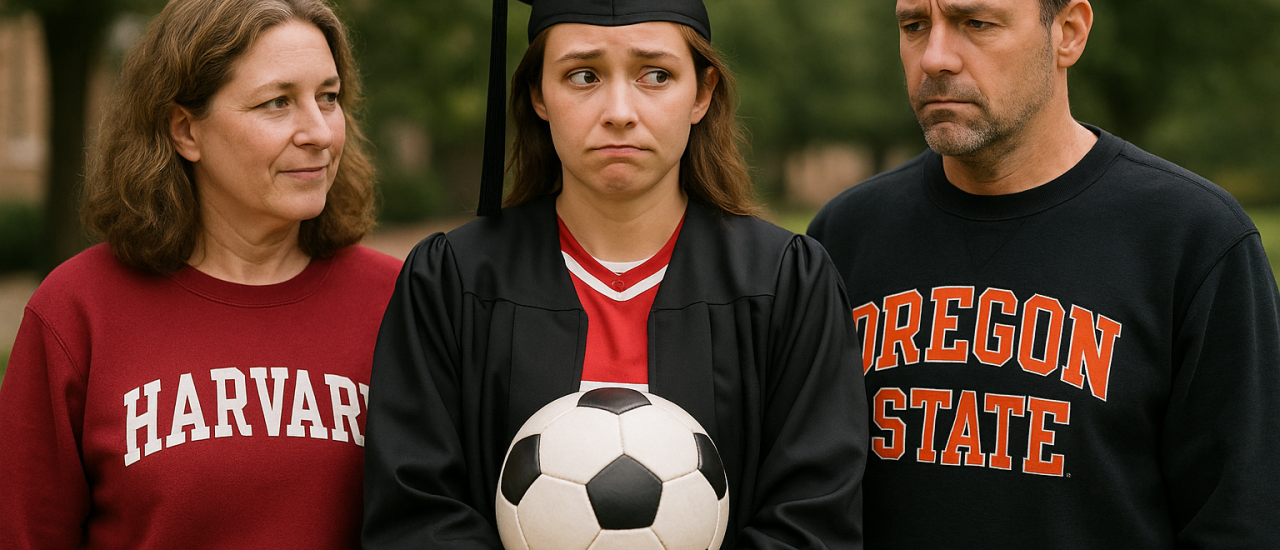
It’s graduation season, which means it’s also the season of pastel dresses, photo backdrops made of balloons, and those telltale Instagram captions: “She believed she could, so she did.” There’s a celebratory air in the school gymnasiums and backyards of America, but lurking just beneath it—especially among the parents of soccer players—is a different emotion: reckoning.
Let’s be honest. Every soccer parent, at some point, dreams their kid will go all the way. Not just college soccer, but the big time: the national team, Europe, a Nike deal, and that satisfying moment when you run into your high school nemesis at the grocery store and casually drop that your son is “on loan at Dortmund.”
But now it’s graduation, and for many of us, the dream is shifting. Johnny isn’t going to Stanford. He’s going to Oregon State. Or Chico State. Or maybe—gasp—he’s done with soccer altogether.
And that’s okay.
What Soccer Parents Think Development Looks Like
In our heads, “development” has long meant forward progress. It’s linear, measurable, and always trending upward. It looks like this:
- U9: Starting winger on the club team
- U11: Academy call-up
- U13: State ODP
- U15: ECNL or MLS Next roster spot
- U17: Scouted by college coaches at showcases
- U18: Signed to a D1 program
- U19: Freshman minutes, eyes on pro dreams
But here’s the kicker (no pun intended): kids aren’t stock portfolios. Soccer development isn’t an index fund. It doesn’t always compound annually. Sometimes it stalls, sometimes it plateaus, sometimes it redirects entirely. Sometimes it leads not to Harvard, but to Oregon State—and even then, it might be as a student, not an athlete. And here’s the thing…that’s okay!
So what, then, is “development,” really?
The Real Definition of Development
Development in soccer isn’t a list of accolades. It’s the process of becoming a better player, a better teammate, and a better person. It includes:
- Learning how to take feedback without crumbling.
- Sitting on the bench and still cheering for your teammates.
- Coming back from an injury more determined than ever.
- Understanding tactics, timing, and decision-making, not just goals and assists.
- Realizing you don’t want to play in college—and making peace with that.
- Choosing a college for the right reasons (academic fit, personal happiness), not just the size of the soccer program’s stadium.
And let’s not pretend that every other area of a kid’s life is held to the same high, almost delusional standards we apply to youth sports. No one says, “Well, she only got into Oregon State for engineering. Guess the dream is over.” You’d say, “That’s amazing!”
But in soccer, anything less than D1 often feels like a funeral for potential.
Soccer Isn’t an SAT Score
The irony of this time of year is stark. We celebrate all kinds of achievements: finishing a tough school year, learning how to drive, discovering new interests, even just surviving the teenage years without fully combusting. But when it comes to soccer, if the destination isn’t a marquee name or a full-ride scholarship, the accomplishment is somehow “less.” How many times have I heard an almost ‘apologetic’ tone when a parent says their child will be playing soccer at a D3 college, or a JuCo, almost feeling necessary to explain why it’s ONLY that school…
This is absurd.
Imagine telling your friend, “My son is going to Oregon State for computer science,” and them replying, “Oh. Not Harvard?” You’d rightfully find that offensive. But we do the same thing in soccer all the time:
- “Oh, he’s just playing club in college, not on the real team?”
- “She didn’t get recruited? But she had so much potential.”
- “He’s quitting after high school? That’s such a shame.”
A shame? Really? Since when did playing a sport for over a decade, making lifelong friends, learning discipline, experiencing competition, and building resilience become something to be ashamed of?
How to Cope When Your Kid Doesn’t “Make It”
Here are a few tips for recalibrating your expectations and embracing what your kid did achieve—even if it wasn’t “Harvard-level” soccer:
1. Redefine Success
Ask yourself: Would you rather your child be a benchwarmer at a top D1 school, miserable and burnt out, or a happy, confident student thriving at a smaller school, playing club or intramurals and loving the game? One builds identity; the other builds resentment.
2. Stop Comparing
Comparison is the thief of joy—and the mother of insecurity. Just because the neighbor’s kid committed to UCLA doesn’t mean yours failed. Everyone’s path is different. If your kid found a place that fits them, you won.
3. Celebrate the Journey, Not the Résumé
Your child woke up for 7:00 AM tournaments. Played in 100-degree heat. Dealt with injuries, tough coaches, tryouts, and heartbreaks. That is growth. That is strength. You cheered from the sidelines (sometimes too loudly), drove endless hours, and paid for god-knows-how-many cleats. You didn’t fail. They didn’t fail.
4. Normalize Walking Away
Not every kid wants to play in college. And that’s fine. If they’ve discovered other passions, that’s development, too. Let them pivot. Life isn’t about pleasing your ego—it’s about becoming who you are.
5. Talk to Former Athletes
Find parents of college athletes, especially D1. Many of them will tell you the same thing: It’s a job. It’s exhausting. And often, it comes with tradeoffs—mental health, social life, time, and academic flexibility. For some, it’s amazing. For others, it’s a gilded cage.
6. Keep the Game Alive
Just because competitive soccer ends doesn’t mean the sport has to. One of the most heartwarming stories we’ve heard recently came from a good friend whose son didn’t get a lot of minutes in high school. He was never a starter, rarely in the spotlight—but he loved the game. And now, in college, he’s playing intramurals, having a blast, and still finding joy in soccer on his own terms. That, in many ways, is the best indicator of real development: he didn’t need a roster spot or a coach’s validation to keep playing. He plays because he loves it.
Adult rec leagues, pickup games, coaching younger players, or even becoming a referee—all of these are meaningful ways to stay involved. The love of the game doesn’t have to end with high school. When a child keeps soccer in their life by choice—not pressure—that’s a powerful, lasting success.
A Final Thought: It’s Not About You
It’s natural for parents to feel deeply connected to their child’s journey—especially when it’s something you’ve invested time, energy, and emotion into for years. Soccer has likely become a shared experience: early mornings, long drives, hotel rooms, sideline snacks, victories, and heartbreaks. So when that chapter comes to a close, or doesn’t turn out the way you once imagined, it can stir up all kinds of feelings.
But it’s important to remember that this journey ultimately belongs to your child. Their path, their pace, and their passions may look different from what you once hoped—but that doesn’t make it any less meaningful or successful. Your role isn’t to steer the outcome, but to support the person they’re becoming through it all.
When we let go of the idea that athletic success validates our parenting or fulfills something in us, we’re better able to appreciate the real growth that’s taken place. Your child may not have ended up where you once envisioned—but they’ve grown, stretched, endured, and discovered who they are. That’s the real win.
P.S.
I went to Oregon State, and played soccer there back in the 90’s. Oregon State has a great soccer program (College Cup in 2023). And a beautiful campus here in Corvallis. And—just like Harvard—coffee shops with overpriced lattes. Come visit anytime. Go Beavs!