
After nearly three decades in and around the game at a high level, I can say this with clarity: I’ve never felt more encouraged by the conversations happening at the national level—particularly in recent days with U.S. Youth Soccer leadership, and US Soccer.
I just returned from meetings in Orlando at the USYS National Championships, and for the first time in a long time, I walked away with something more than just a folder full of talking points—I walked away with hope. Hope that we’re entering a new era. One where real change isn’t just being discussed but recognized as necessary and actively being planned for. One where people at the highest levels of the game are finally seeing the cracks in the system not as inconvenient realities to work around, but as urgent problems to solve.
This is a pivotal moment for youth soccer in the US. Not because the 2026 World Cup is coming. Not because of expanded professional opportunities. But because—regardless of whether we’re hosting the world or not—we owe it to our players, families, and coaches to build something better. Something clearer. Something cohesive. Something truly developmental. And above all, something unified.
A Fractured Ecosystem Isn’t a Healthy One
Let’s say the quiet part out loud: our current youth soccer landscape is fractured. Too many factions. Too many pathways. Too many parallel versions of the “top” level. And what we end up with is not a tiered system that gives players a logical place to land based on their developmental needs. Instead, we get something more like a shallow pool—wide, expansive, and confusing, but not very deep anywhere.
We’ve created a landscape where families are overwhelmed with choices that feel different in name only. Too often, we see leagues and platforms offering essentially the same level of play, the same travel expectations, and the same commitments—but marketed as distinct opportunities. That’s not development. That’s dilution.
And the root of that dilution, in my view, is the absence of a clear, unified direction from U.S. Soccer. Without national cohesion, we’ve left a vacuum for others to fill. Every organization, every league, every “platform” scrambles to build its own ecosystem. And while competition is healthy in some industries, in youth sports—particularly a national sport like soccer—too much competition for relevance creates instability, confusion, and ultimately inequity.
This Isn’t Business. It’s Youth Development.
We’ve made the mistake—collectively—of applying a capitalist mindset to youth soccer. “Let the best model win.” “The market will decide.” “Clubs will follow what’s best for them.” Those phrases might sound logical in theory, but in practice, they’ve led us to where we are today: a marketplace of diluted options, ambiguous standards, and exhausted families who just want to know where their kid belongs.
Capitalism is a wonderful system when you’re selling coffee or software. But when the goal is player development, community building, and long-term athletic growth, then we need something stronger than competition. We need collaboration.
In youth soccer, our job isn’t to “win the market.” Our job is to develop the market—and more importantly, the players in it. That starts with alignment around shared values, agreed-upon standards, and—critically—a clear and cohesive pathway.
One Pathway. Multiple On-Ramps. Shared Pillars.
It’s time to stop pretending that multiple competing national platforms help the game. They don’t. They confuse the consumer, overwhelm the club leader, and create inefficiencies that ultimately trickle down to the kids.
What we need is one pathway—not in the sense of a rigid, single-lane highway—but rather a clear road forward that includes defined standards, pillars we all agree to uphold, and sensible on-ramps for players of different levels, abilities, and goals. A tiered system, properly aligned and communicated, can support everyone—from the grassroots volunteer club in a town of 800 to the professional academy training future internationals.
But the foundation must be shared. The pyramid must be real. And the standards must be enforced—not just aspirational checkboxes but actual accountability for how we define, support, and measure success.
We need to stop chasing the illusion that multiple pathways can each be elite. They can’t. We don’t need a dozen separate lanes—we need one strong pipeline, clearly defined, with options for entry and reasonable places for players to “top out” and stay connected. Not every kid becomes a national team player, but every kid should feel they’re part of the system. And their value shouldn’t be determined by how far up the pyramid they climb.
A Moment of Reflection: The National Team
Let’s be honest—there’s very little hope that the U.S. Men’s National Team is going to win a World Cup next year. That’s not a dig at the players or the coaching staff—it’s not for a lack of desire or passion. But we still have to ask the hard question: Why, in a country of 350 million people, can we only seem to produce one or two players at a time who can compete consistently at the highest levels of global football?
As someone who’s English, I’ll admit my bias—I think England might have a real shot at winning next time. But that’s not just about talent. It’s because underneath it all, there’s a cohesive, centralized football association that supports a unified structure from the grassroots up. The same is true for Germany, Spain, France, and other footballing nations that not only compete but sustain excellence on the international stage.
We can’t keep falling back on the excuse that the U.S. system is “still new.” It’s not new anymore. It’s just disorganized. We need direction. The kind of direction that the English FA has. The kind of direction the DFB has. Not just for the national teams, but across the entire youth ecosystem. From coaching standards to club licensing to talent identification—everything needs to be part of a larger, aligned structure.
Because when the foundation is disjointed, the elite level can only go so far. You can’t build a high-performing national team on a fractured youth system. It’s not sustainable.
Redefining What Success Looks Like
One of the points I raised in my conversations with U.S. Soccer this week was about metrics. We love our statistics in American soccer—how many players made it to college. How many signed pro contracts. How many earned national team caps.
But for the 98.5% of kids who don’t fall into any of those buckets, what kind of data are we tracking? What metrics do we have to celebrate the players who didn’t “make it” as professionals, but went on to become great human beings? Great parents? Great coworkers? Great citizens?
We don’t. We don’t measure those outcomes.
Yet, for the overwhelming majority of youth players, that is the real outcome. They’re not future internationals—they’re future teachers, nurses, engineers, firefighters, and entrepreneurs. And they’re taking with them the discipline, teamwork, leadership, and resilience that this game taught them.
But right now, we summarize their journey with a single word: didn’t make it. That’s not just unfair—it’s inaccurate.
This fixation on producing elite talent has led us to over-engineer a system with too many leagues, too many false promises, and too many fragmented routes to the top. And when that elite dream doesn’t pan out, players often feel like they failed. In truth, they simply reached their peak potential in soccer, and now they’re thriving elsewhere.
We need a pipeline that reflects that reality. One unified system that elevates the best to the top, yes—but also honors and embraces those who plateau, shift gears, or move on. Not everyone gets a cap, but everyone should get dignity.
Direction Over Perfection
In one of our sessions this week in Orlando, I said this to a group of U.S. Soccer leaders: People will follow a direction—even if it’s wrong. What they won’t do is follow an organization that forever treads water.
And I meant that.
We can debate the details of the new direction. We can—and should—course correct when we get something wrong. But we must move. And we must move together.
The paralysis we’ve suffered over the last decade hasn’t been because of a lack of ideas. It’s been because of a lack of national resolve. No one wants to be the organization that draws a line in the sand. Everyone’s afraid to lose a constituency, or offend a partner, or disrupt the fragile balance of power. But here’s the reality: the balance is already broken. What we need is the courage to rebuild it in a better, clearer, and more equitable way.
What Gives Me Hope
I’ve been in this space long enough to know the difference between a marketing pitch and a meaningful conversation. What I heard in Orlando this week were the beginnings of meaningful conversations.
There was honesty in the room. People acknowledged the fragmentation. There was energy—real momentum behind the idea that we can’t keep patching leaks in the dam. And most importantly, there was recognition that if we are ever going to unify, we must act now, not later.
We have the opportunity to realign under USYS and U.S. Soccer with a new model that is simpler, stronger, and fairer. One that restores faith among families and clubs alike. One that doesn’t cater only to the top, but also nurtures the base. One that respects regional realities while holding national aspirations.
This will not be easy work. There will be tough conversations. Some platforms and leagues may sunset. Others will have to evolve. But if we stay focused on why we are doing this—for the kids, for the future, for the game—then we can build something lasting.
A Real Solution: Structure, Simplicity, and Shared Purpose
So, what do we do?
Here’s my solution—and I say this with full awareness that it will ruffle feathers: we simplify. We unify. We formalize a system that already loosely exists, but we give it structure and legitimacy.
It starts with the state associations. We should continue to be the single point of registration for youth soccer players in the U.S. We already serve the largest number of players in the country, and—humbly—we do a damn good job. We understand our communities. We know the landscape. We support the broad middle of the soccer population.
(EDIT: lots of great feedback on the article, but questions about why ECNL. Bottom line I just picked one of them. It could be ECNL, or GA, or MLS, or (preferably?) something completely new…but it needs to be a SINGLE platform entity.)
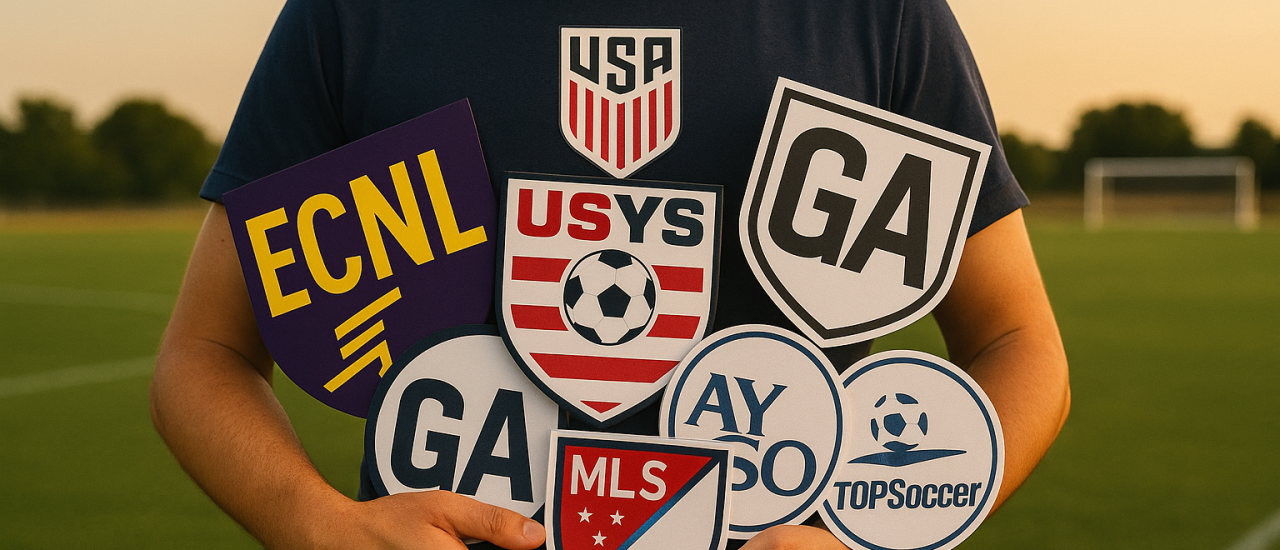
Then, above us, you have one elite national platform: ECNL. Not two or three. Not four. One. ECNL becomes the official top tier—full stop. No more MLS Next Tier 2, no more GA, no more overlapping and competing elite ecosystems. Sunset them. Consolidate. And from each state, a maximum of 15% of clubs earn ECNL certification. Not everyone gets in. That’s the point. It should be exclusive, and the expectations should be higher across the board: coaching standards, financial standards, operational standards. It’s not a badge of honor—it’s a job.
The 85% that don’t fall into that top tier stay with us, the state associations, and compete in formal, state-run leagues. These leagues serve the majority, and they provide a clear pathway into the elite tier for those who earn it. Evaluations happen regionally, centrally, and regularly. Players can move up. Clubs can grow into elite status. But the default is no longer “everyone is elite.” It’s that most are developmental, and that’s not a failure—it’s a strength.
Then, let’s fully embrace the bottom 15% as well, through organizations like AYSO. I’m a huge fan of what AYSO does. They are phenomenal. Their model of volunteer coaching, short seasons, and local rec play is critical—and they do it better than anyone. Let them own that space, with clarity and pride. Not every kid needs or wants a pathway to the top, and that’s okay. They still deserve a place in the pyramid.
So that’s my idea:
- Top 15%: ECNL only. High expectations, elite players, centralized identification, real standards, but limited to a small number of clubs that ONLY do that.
- Middle 70%: State association-run leagues, licensed and supported, where most of our youth development happens. Kids graduate out of the clubs in these leagues, and into the ECNL.
- Bottom 15%: AYSO and similar organizations for local, recreational play. No pressure. Just joy.
Now, there will be challenges—especially when it comes to access to those top 15% of clubs. That’s real. We’ll need solutions for kids in remote areas or underserved communities. But that’s a small percentage of the population and not an insurmountable problem. With creativity, support, and investment, we can solve it.
If—and only if—ODP is given the same level of national standing and resources as ECNL, it could serve as an alternative top-tier identification pathway. But it has to be lifted to that level, not left to operate in the shadows of private leagues.
This model is simple. It’s scalable. It honors where kids are at and gives them room to move. It removes the confusion. It makes development intentional, not incidental.
And maybe most importantly: it restores belief.