• Skip to main content
  • Skip to primary navigation
  • Español
  • Resources
  • Affinity Login
  • Team Shop
  • USYS
USYS Oregon

USYS Oregon

  • About Us
    • Staff
    • Board Of Directors
      • Annual General Meeting
    • Hall Of Fame
    • Events
    • Technical Advisory Committee
    • Soccer Landscape
    • OYSA Foundation
    • Sponsors & Partners
    • Employment
    • Goal Lines Magazine
    • Contact
    • News
  • Leagues
    • 2025/26 League Structure
    • Competitive
      • Fall U11 – U15
      • Winter (U15–19)
      • Spring – U11-14
    • Developmental
      • Valley Academy League U9 – U10
      • Development League
    • Sanctioned Leagues
    • Find A Club
  • Tournaments
    • Overview
    • State Cup
    • Presidents Cup
    • Founders Cup
    • League America Festival United Cup
    • Sanctioned Tournaments
  • ODP
    • Tryouts
    • Coaching Staff
    • FAQs
    • ODP Calendar
    • ODP Liability/Release Forms
  • Referees
    • Become a Referee
    • Laws of the Game
    • Ref Talk with Scott
    • Reftown
    • Referee Training
  • Coaches
    • Licensing Pathway
    • Starting Out
    • Upcoming Courses
    • Host a Course
    • Coaching Resources
    • No Tippy Tappy – Lessons & Exercises
  • Parents
    • Soccer Parenting
    • Sideline Project
    • How to Register a Parent
    • Code of Ethics
    • Parent Resources
  • Programs
    • TOPSoccer
    • College Showcase
    • Away Day Perks
    • Roundglass Living
    • Engine – OYSA Travel Partner
  • Admin
    • Becoming a Member Club
    • OYSA Competition Rules
    • International Clearance
    • Forms & Documents
    • Background Checks
    • Safe Sport
    • Risk Management
  • Esports
    • Benefits
    • Safety
    • FAQs
    • Español
    • Resources
    • Affinity Login
    • Team Shop
    • USYS

General

2026/2027 Updated Decision on Age Group Formation

December 3, 2025 by rkackley

Following extensive review and discussion, US Youth Soccer, AYSO, and US Club Soccer have collectively decided to move to an age group player formation cycle that runs from August 1 to July 31, starting with the 2026-27 season/registration year. This change was made based on additional critical feedback, data, and expert input to better align players with their school-grade peers. Our associations feel that this age group player formation will be the most inclusive and help increase participation.
The August 1 to July 31 age group player formation cycle will be used for all USYS league and Cup competitions for the 2026-27 season/registration year including: National Championships, Presidents Cup, and National League.
US Youth Soccer CEO Tom Condone addressed the adjustment to the registration process: “At US Youth Soccer, our mission is to support the development of every player. After careful collaboration with our partners and listening to our membership, we believe this shift to an August 1 player formation cycle better aligns with school calendars, supports social and individual needs, and ultimately enhances the youth soccer experience for families across the country.”
As a reminder, under US Soccer’s new policy, each Federation member can determine age group registration rules for the leagues and competitions they operate or sanction. To support this transition, US Soccer has introduced a tool to help parents and guardians easily understand the age groupings based on their child’s birthdate.
Again, please note that this decision is effective beginning with each Organization Member’s 2026-27 season/registration year.
2026/2027 Age Grouping Rationale

  • Transitioning to an 8/1-7/31 age grouping is a return to the former grouping prior to 2017. Calendar birth year was mandated by US Soccer when most youth soccer was previously using school age.
  • The mandate has been removed, allowing US Soccer Member Organizations the ability to group players as they see fit.
  • The majority of youth soccer is non-competitive/recreational. The benefits of youth sport participation are numerous, but USYS feels that the social elements are some of the most important.
  • While using the calendar birth year age grouping, USYS heard frequently from families asking for their children to play with their classmates.
  • Using the school year grouping creates the fewest trapped players.
  • USYS feels that school year grouping promotes stronger team chemistry and retention by allowing children to play with their schoolmates and closest friends.
  • Grouping by school year often places players in a more consistent emotional and physical developmental environment.
  • School age grouping will help college recruitment. Players of the same graduating class will be participating together in high-level tournaments and matches.

When Politics Follow Kids onto the Soccer Field

November 3, 2025 by sdate

I try hard to avoid political posts. I’ll do my best here, too, but this is necessary. There are bigger global issues and larger national debates than anything happening in youth sports. But this week, I received two emails that hit me in the gut and reminded me why the work we do isn’t just transactional. It’s also deeply human.

The first email came from a club admin whose players come from immigrant and refugee families. This is what she wrote:

“With increased ICE activity, and an escalation of violent tactics, our families are scared. They are afraid to leave their homes, and attending soccer games has come up as a point of concern, especially after ICE was spotted at local parks where soccer games were occurring this weekend. What policies are being enacted at game locations to ensure safety for our families and athletes?”

These are children. Kids who just want to play, laugh, and compete… now afraid that attending a soccer game might put their families at risk. That should stop all of us in our tracks.

Within 24 hours, I received another message — this one from a parent about playing time, and whether a player was getting the minutes they believed they deserved. It was sent with urgency and frustration. An excerpt:

“We’re very concerned that my child is not being given fair and equal opportunities on the field, and that decisions about playtime may be compromising their development and experience this season.”

Normally, these two messages would never coexist in the same emotional space. I receive versions of both all the time. But to see them back-to-back — one about a child’s safety, the other about a child’s minutes — made me pause.

On one hand: ➡️ “Why isn’t my child playing more?”

On the other: ➡️ “Our children are scared to attend their own games.”

Let me be clear: both concerns, in their own worlds, matter. If you care about your child’s development, I respect that. We all do. But side-by-side, these emails forced perspective.

Youth sports can be incredibly transactional — schedules, standings, rosters, game times, fields, payments, logistics. But they are also profoundly human — safety, belonging, dignity, joy, identity, and community.

When the political climate becomes so intense that kids are afraid to go outside and play, something is broken. Not in soccer — in society.

Before putting on their jersey, no child should ever have to ask:

“Is it safe for me to go to my soccer game?”

We can debate competition, development, and playing time all day long — and yes, those discussions have their place. But humanity must come first. Always.

To the families who are afraid right now: We see you. We care. We are working with U.S. Soccer, USYS, local partners, and community organizations to do everything within our power to keep our environments safe, welcoming, and inclusive. Even though we are, rightly so, bound by laws and law enforcement actions outside our control, we will not look away from your fear or your reality.

And to all of us — myself included — who get caught up in the heat of competition: maybe every now and then, we zoom out and remember that for some families, stepping onto a soccer field is not just a game. It’s an act of courage.

If our mission is truly “for all kids,” then all must mean all.

Even when — and especially when — the world outside the touchline tries to say otherwise.

SIDENOTE: If you’re interested in my reply regarding the ICE email, I’ve pasted it below.

— Simon

Executive Director, Oregon Youth Soccer Association


Hi (name removed),

Thank you for writing and sharing your concerns — I want you to know that I deeply appreciate you reaching out under such stressful circumstances, and my sincere sympathy goes out to your families and players who are feeling afraid right now.

I want to be clear about where things stand with U.S. Immigration and Customs Enforcement (ICE) and our limitations: unfortunately, the Oregon Youth Soccer Association is at the mercy of law enforcement’s discretion when it comes to ICE operations. We do not have the authority to prevent ICE from being present at public parks or events, and if they show up, we must comply with what they ask. While we can coordinate and plan, we cannot override federal law-enforcement actions.

That said, I want to assure you that we are actively in conversation with U.S. Soccer Federation and U.S. Youth Soccer about how we can better support diverse teams, immigrant and refugee families, and ensure the safest possible environment for participation. These discussions include how to share best practices, how to communicate with families, and how to work with local jurisdictions to monitor enforcement activity and its impact on youth sports events.

In parallel, while we recognize these ideas might sound a little unconventional or “outside the box”, here are some suggested strategies we could propose to teams and families – not as guarantees, but as tools to increase awareness, preparedness and a sense of control:

  • Establish a “lookout” / buddy network – Within the team/community, nominate a few trusted adults who agree to keep a lookout around the park-venue before/during matches, to monitor for unfamiliar vehicles, unusual activity by plain-clothes individuals, or ICE-style uniforms/vehicles.
  • Pre-game gathering zones – Encourage families to arrive a little early and gather in a safe, visible location (perhaps closer to the field entrance) so the athletes and families aren’t isolated deep in the park. Visibility often reduces risk.
  • Mobile tracking of movements – Families who feel at risk could share arrival times, park locations, car-pool routes, so someone knows when and how they are traveling in. A simple group text or app check-in could help someone log “we’ve arrived / we’re leaving”.
  • Use of “Know Your Rights” websites/resources – While this is not specific to games, being informed helps. For example, the Immigrant Legal Resource Center has toolkits and downloadable “Know Your Rights” guides for encounters with ICE. Immigrant Legal Resource Center+2National Immigrant Justice Center+2
  • Social media / community alerts – In some places, immigrant communities share alerts when ICE activity is reported (though this has caveats, including the risk of panic or misinformation). For instance, community groups in Florida have used Instagram to post alerts about ICE sightings. Axios
  • Safe-space orientation for children – Encourage families to talk with athletes about what to do if they feel threatened: go with a trusted adult, stay in groups, avoid isolated parking lots, and have a designated “safe adult” on site who children know they can go to if they feel unsure.
  • Coordinate with park authorities/local law enforcement – We could ask the park department or local police to increase visibility at game sites (e.g., more patrol cars, lighting, signage) and communicate that this is a youth sports event with diverse participants and families who may feel vulnerable.
  • Alternate venue options – If feasible, consider choosing venues that are closer to the home area of families (so travel is shorter), or in well-lit, busy parks (rather than remote fields) to reduce opportunity for unnoticed enforcement activity.

Again, I want to emphasize that none of the above can guarantee avoidance of ICE activity, but they may help families feel more aware and prepared rather than feeling powerless.

We will continue working with U.S. Soccer and USYS to advocate for clearer protocols and resources that our member clubs can deploy. I will make sure to keep you updated as soon as we have more concrete steps or policy tools to share.

Please let your families know that their safety and sense of belonging matter to us. If any of your players or families would like direct resource links (in Spanish, or other languages) for “know your rights” or community legal clinics, I would be happy to send those over. Thank you again for bringing this to our attention and for your leadership in caring for a diverse and inclusive team environment.

I feel the angst and pain in your email, and as ‘professional’ as I tried to write my response, I’ll put on my human hat, and be less professional for a second and say that is it complete bullshit that we’re having to have this conversation about kids playing soccer in our communities and that they have to think about this instead of just going out and playing the beautiful game.

With empathy and solidarity,

Simon

When Leaders Get It Wrong: Owning Mistakes, Learning, and Moving Forward

November 2, 2025 by sdate

In leadership, you eventually face a truth that no book or training can fully prepare you for: sometimes you make a decision with the best of intentions, with the data to back it up, and with full confidence that it’s the right move—only to find out, painfully, that you got it wrong.

That was me this past month.

It was September 12th, and I was standing in a line of cars, waiting for a ferry to Lopez Island just 15 miles from Canada, so I could be at a wedding of a former player (whom I adore), and I just felt like I had let down thousands of kids playing soccer in Oregon.

You see, a few months earlier, I decided to bring our scheduling in-house. On paper, it looked like the right move. The numbers worked. The rationale was solid. The team believed in it. And we weren’t doing it to cut corners—we wanted to take greater ownership of one of the most important services we provide, improve efficiencies, and set ourselves up for long-term growth.

But the truth is: I missed the mark.

The rollout didn’t go as planned. For a few weeks, our service to members wasn’t where it needed to be. And even though that window was relatively shorten a calendar page, in youth sports a few weeks of disruption is enough to create frustration, stress, and doubt. Parents, players, coaches, referees—they rely on us for structure, and we didn’t deliver at the level they deserve.

That stung.

Why I Made the Decision

Decisions like this don’t happen lightly. I considered it carefully, weighing the potential benefits:

Control: By managing scheduling ourselves, we could tailor solutions and respond more quickly.

Cost efficiency: The huge financial numbers suggested we could funnel that money elsewhere while maintaining, or even improving, quality of coaching education, TOPSoccer, and scholarships for kids in need. In fact, cost was. major driver. Our scheduler is fantastic, and there was never doubt about quality.

Long-term growth: Bringing scheduling in-house seemed like a way to scale for the future.

On paper, it all made sense. But real life has a way of exposing what spreadsheets can’t capture.

Where It Went Wrong

Despite planning and preparation, the reality of in-house scheduling proved more challenging than expected. Processes that looked simple in theory became complex in practice. Communication lagged. Our ability to meet the needs of members—families, coaches, referees—slipped, even if only for a short stretch of time.

In our line of work, service is everything. People don’t experience our intentions; they experience the outcomes. And the outcome, in this case, wasn’t good enough.

Taking Accountability

When something goes wrong, often the question is simple: Who’s responsible?

The answer is me.

Our team worked tirelessly and did everything asked of them. They believed in the decision and poured themselves into the execution. But leadership isn’t about deflecting blame. It’s about absorbing the hit so your team doesn’t have to.

That’s what accountability means—and I won’t sugarcoat it: it hurt. I care deeply about the trust our members place in us. When that trust is shaken, even briefly, you feel the weight of it. I felt different. My kids could tell something was up with dad. My wife could definitely tell.

By The Way, This Isn’t About Sympathy

I want to be clear: this article isn’t written to garnish sympathy or elicit praise for “eventually making the right decision.” Correcting mistakes is the bare minimum of leadership, not something to be congratulated for.

I wasn’t even going to post this on LinkedIn, but wanted to so that if nothing else, I can look back on it in a few years and remember what this felt like. It’s not really genuine if I, or anyone else, gives the impression that we only have wins in Oregon. I written about those, but then sometimes we lose.

The point of sharing this is simpler: we have to be willing to own the setbacks as openly as we celebrate the wins. Not because it feels good—trust me it doesn’t—but because it’s the only way to truly get better.

The Response

When we made the call to return to our previous vendor, who is superb, the response was immediate and positive. Members appreciated the course correction, and the frustration that had built up quickly began to ease. It didn’t disappear but it did mean that it gradually subsided.

That reaction from members underscored the most important lesson of all: no matter how strong the numbers or logic may seem, nothing matters more than service.

It’s easy to say we prioritize service. It’s much harder when a big, bold decision inadvertently gets in the way. But this experience reminded me that service isn’t just a value to list on paper—it’s the ultimate measure of whether we’re succeeding.

Lessons Learned

Looking back, a few lessons stand out:

Good intentions don’t erase poor outcomes. Members don’t experience why we made the decision—they experience the service they receive.

Spreadsheets can’t capture human impact. Financial models and projections are helpful, but they don’t reflect the stress and disruption people feel when service dips.

Transparency matters. Saying “we got this wrong” builds more trust than pretending everything went as planned. People see through that.

Leadership means taking the hit. It’s my job to stand in front and absorb the criticism so the team can keep moving forward.

Service is the ultimate metric. At the end of the day, nothing else matters more.

Putting It in Perspective

This was a blip, and a step back, but it doesn’t define us. We’ve done a tremendous amount of good in the past year, and I believe we’ve positioned ourselves to make soccer in Oregon stronger than it has ever been.

We’ve built new opportunities, created new structures, invested in programs, and strengthened partnerships. We’ve created momentum that excites me for the future.

This stumble doesn’t undo that progress—but it does sharpen our focus. It reminds us that growth isn’t a straight line. It’s a mix of steps forward and, sometimes, a step back. What matters is what we learn from it, and how we move forward.

Moving Forward

Our vendor partner is back. The process is stable. Families and coaches can count on us again for the reliability they deserve.

But this experience is going to inform every decision we make moving forward. It reminded me that risk-taking is important, but only if we keep service as the lens through which every decision is evaluated.

I don’t regret trying. Innovation always carries risk, and playing it safe is rarely the path to growth. But I do regret that our attempt created disruption for those who count on us most. That’s why accountability matters, and why this lesson will stay with me.

A Final Thought

Sitting here writing this in Kansas City while at the USYS Leadership Symposium, I am reminded that leadership isn’t about never getting it wrong. It’s about having the courage to admit when you do, the humility to absorb the consequences, and the commitment to use the experience to get better. I’ll at least give myself some credit for that.

We stumbled. We owned it. We fixed it. And now, we move forward with even greater clarity: service above everything else.

That’s not just a lesson for scheduling—it’s a lesson for leadership, and we’ve talked about that a lot in meetings this week.

Real Change Is Coming to Youth Soccer. Now We Must Get It Right.

July 29, 2025 by sdate

After nearly three decades in and around the game at a high level, I can say this with clarity: I’ve never felt more encouraged by the conversations happening at the national level—particularly in recent days with U.S. Youth Soccer leadership, and US Soccer.

I just returned from meetings in Orlando at the USYS National Championships, and for the first time in a long time, I walked away with something more than just a folder full of talking points—I walked away with hope. Hope that we’re entering a new era. One where real change isn’t just being discussed but recognized as necessary and actively being planned for. One where people at the highest levels of the game are finally seeing the cracks in the system not as inconvenient realities to work around, but as urgent problems to solve.

This is a pivotal moment for youth soccer in the US. Not because the 2026 World Cup is coming. Not because of expanded professional opportunities. But because—regardless of whether we’re hosting the world or not—we owe it to our players, families, and coaches to build something better. Something clearer. Something cohesive. Something truly developmental. And above all, something unified.

A Fractured Ecosystem Isn’t a Healthy One

Let’s say the quiet part out loud: our current youth soccer landscape is fractured. Too many factions. Too many pathways. Too many parallel versions of the “top” level. And what we end up with is not a tiered system that gives players a logical place to land based on their developmental needs. Instead, we get something more like a shallow pool—wide, expansive, and confusing, but not very deep anywhere.

We’ve created a landscape where families are overwhelmed with choices that feel different in name only. Too often, we see leagues and platforms offering essentially the same level of play, the same travel expectations, and the same commitments—but marketed as distinct opportunities. That’s not development. That’s dilution.

And the root of that dilution, in my view, is the absence of a clear, unified direction from U.S. Soccer. Without national cohesion, we’ve left a vacuum for others to fill. Every organization, every league, every “platform” scrambles to build its own ecosystem. And while competition is healthy in some industries, in youth sports—particularly a national sport like soccer—too much competition for relevance creates instability, confusion, and ultimately inequity.

This Isn’t Business. It’s Youth Development.

We’ve made the mistake—collectively—of applying a capitalist mindset to youth soccer. “Let the best model win.” “The market will decide.” “Clubs will follow what’s best for them.” Those phrases might sound logical in theory, but in practice, they’ve led us to where we are today: a marketplace of diluted options, ambiguous standards, and exhausted families who just want to know where their kid belongs.

Capitalism is a wonderful system when you’re selling coffee or software. But when the goal is player development, community building, and long-term athletic growth, then we need something stronger than competition. We need collaboration.

In youth soccer, our job isn’t to “win the market.” Our job is to develop the market—and more importantly, the players in it. That starts with alignment around shared values, agreed-upon standards, and—critically—a clear and cohesive pathway.

One Pathway. Multiple On-Ramps. Shared Pillars.

It’s time to stop pretending that multiple competing national platforms help the game. They don’t. They confuse the consumer, overwhelm the club leader, and create inefficiencies that ultimately trickle down to the kids.

What we need is one pathway—not in the sense of a rigid, single-lane highway—but rather a clear road forward that includes defined standards, pillars we all agree to uphold, and sensible on-ramps for players of different levels, abilities, and goals. A tiered system, properly aligned and communicated, can support everyone—from the grassroots volunteer club in a town of 800 to the professional academy training future internationals.

But the foundation must be shared. The pyramid must be real. And the standards must be enforced—not just aspirational checkboxes but actual accountability for how we define, support, and measure success.

We need to stop chasing the illusion that multiple pathways can each be elite. They can’t. We don’t need a dozen separate lanes—we need one strong pipeline, clearly defined, with options for entry and reasonable places for players to “top out” and stay connected. Not every kid becomes a national team player, but every kid should feel they’re part of the system. And their value shouldn’t be determined by how far up the pyramid they climb.

A Moment of Reflection: The National Team

Let’s be honest—there’s very little hope that the U.S. Men’s National Team is going to win a World Cup next year. That’s not a dig at the players or the coaching staff—it’s not for a lack of desire or passion. But we still have to ask the hard question: Why, in a country of 350 million people, can we only seem to produce one or two players at a time who can compete consistently at the highest levels of global football?

As someone who’s English, I’ll admit my bias—I think England might have a real shot at winning next time. But that’s not just about talent. It’s because underneath it all, there’s a cohesive, centralized football association that supports a unified structure from the grassroots up. The same is true for Germany, Spain, France, and other footballing nations that not only compete but sustain excellence on the international stage.

We can’t keep falling back on the excuse that the U.S. system is “still new.” It’s not new anymore. It’s just disorganized. We need direction. The kind of direction that the English FA has. The kind of direction the DFB has. Not just for the national teams, but across the entire youth ecosystem. From coaching standards to club licensing to talent identification—everything needs to be part of a larger, aligned structure.

Because when the foundation is disjointed, the elite level can only go so far. You can’t build a high-performing national team on a fractured youth system. It’s not sustainable.

Redefining What Success Looks Like

One of the points I raised in my conversations with U.S. Soccer this week was about metrics. We love our statistics in American soccer—how many players made it to college. How many signed pro contracts. How many earned national team caps.

But for the 98.5% of kids who don’t fall into any of those buckets, what kind of data are we tracking? What metrics do we have to celebrate the players who didn’t “make it” as professionals, but went on to become great human beings? Great parents? Great coworkers? Great citizens?

We don’t. We don’t measure those outcomes.

Yet, for the overwhelming majority of youth players, that is the real outcome. They’re not future internationals—they’re future teachers, nurses, engineers, firefighters, and entrepreneurs. And they’re taking with them the discipline, teamwork, leadership, and resilience that this game taught them.

But right now, we summarize their journey with a single word: didn’t make it. That’s not just unfair—it’s inaccurate.

This fixation on producing elite talent has led us to over-engineer a system with too many leagues, too many false promises, and too many fragmented routes to the top. And when that elite dream doesn’t pan out, players often feel like they failed. In truth, they simply reached their peak potential in soccer, and now they’re thriving elsewhere.

We need a pipeline that reflects that reality. One unified system that elevates the best to the top, yes—but also honors and embraces those who plateau, shift gears, or move on. Not everyone gets a cap, but everyone should get dignity.

Direction Over Perfection

In one of our sessions this week in Orlando, I said this to a group of U.S. Soccer leaders: People will follow a direction—even if it’s wrong. What they won’t do is follow an organization that forever treads water.

And I meant that.

We can debate the details of the new direction. We can—and should—course correct when we get something wrong. But we must move. And we must move together.

The paralysis we’ve suffered over the last decade hasn’t been because of a lack of ideas. It’s been because of a lack of national resolve. No one wants to be the organization that draws a line in the sand. Everyone’s afraid to lose a constituency, or offend a partner, or disrupt the fragile balance of power. But here’s the reality: the balance is already broken. What we need is the courage to rebuild it in a better, clearer, and more equitable way.

What Gives Me Hope

I’ve been in this space long enough to know the difference between a marketing pitch and a meaningful conversation. What I heard in Orlando this week were the beginnings of meaningful conversations.

There was honesty in the room. People acknowledged the fragmentation. There was energy—real momentum behind the idea that we can’t keep patching leaks in the dam. And most importantly, there was recognition that if we are ever going to unify, we must act now, not later.

We have the opportunity to realign under USYS and U.S. Soccer with a new model that is simpler, stronger, and fairer. One that restores faith among families and clubs alike. One that doesn’t cater only to the top, but also nurtures the base. One that respects regional realities while holding national aspirations.

This will not be easy work. There will be tough conversations. Some platforms and leagues may sunset. Others will have to evolve. But if we stay focused on why we are doing this—for the kids, for the future, for the game—then we can build something lasting.

A Real Solution: Structure, Simplicity, and Shared Purpose

So, what do we do?

Here’s my solution—and I say this with full awareness that it will ruffle feathers: we simplify. We unify. We formalize a system that already loosely exists, but we give it structure and legitimacy.

It starts with the state associations. We should continue to be the single point of registration for youth soccer players in the U.S. We already serve the largest number of players in the country, and—humbly—we do a damn good job. We understand our communities. We know the landscape. We support the broad middle of the soccer population.

(EDIT: lots of great feedback on the article, but questions about why ECNL. Bottom line I just picked one of them. It could be ECNL, or GA, or MLS, or (preferably?) something completely new…but it needs to be a SINGLE platform entity.)

Then, above us, you have one elite national platform: ECNL. Not two or three. Not four. One. ECNL becomes the official top tier—full stop. No more MLS Next Tier 2, no more GA, no more overlapping and competing elite ecosystems. Sunset them. Consolidate. And from each state, a maximum of 15% of clubs earn ECNL certification. Not everyone gets in. That’s the point. It should be exclusive, and the expectations should be higher across the board: coaching standards, financial standards, operational standards. It’s not a badge of honor—it’s a job.

The 85% that don’t fall into that top tier stay with us, the state associations, and compete in formal, state-run leagues. These leagues serve the majority, and they provide a clear pathway into the elite tier for those who earn it. Evaluations happen regionally, centrally, and regularly. Players can move up. Clubs can grow into elite status. But the default is no longer “everyone is elite.” It’s that most are developmental, and that’s not a failure—it’s a strength.

Then, let’s fully embrace the bottom 15% as well, through organizations like AYSO. I’m a huge fan of what AYSO does. They are phenomenal. Their model of volunteer coaching, short seasons, and local rec play is critical—and they do it better than anyone. Let them own that space, with clarity and pride. Not every kid needs or wants a pathway to the top, and that’s okay. They still deserve a place in the pyramid.

So that’s my idea:

  • Top 15%: ECNL only. High expectations, elite players, centralized identification, real standards, but limited to a small number of clubs that ONLY do that.
  • Middle 70%: State association-run leagues, licensed and supported, where most of our youth development happens. Kids graduate out of the clubs in these leagues, and into the ECNL.
  • Bottom 15%: AYSO and similar organizations for local, recreational play. No pressure. Just joy.

Now, there will be challenges—especially when it comes to access to those top 15% of clubs. That’s real. We’ll need solutions for kids in remote areas or underserved communities. But that’s a small percentage of the population and not an insurmountable problem. With creativity, support, and investment, we can solve it.

If—and only if—ODP is given the same level of national standing and resources as ECNL, it could serve as an alternative top-tier identification pathway. But it has to be lifted to that level, not left to operate in the shadows of private leagues.

This model is simple. It’s scalable. It honors where kids are at and gives them room to move. It removes the confusion. It makes development intentional, not incidental.

And maybe most importantly: it restores belief.

SCA Champs 2025

July 29, 2025 by sdate

Orlando, FL
July 25, 2025
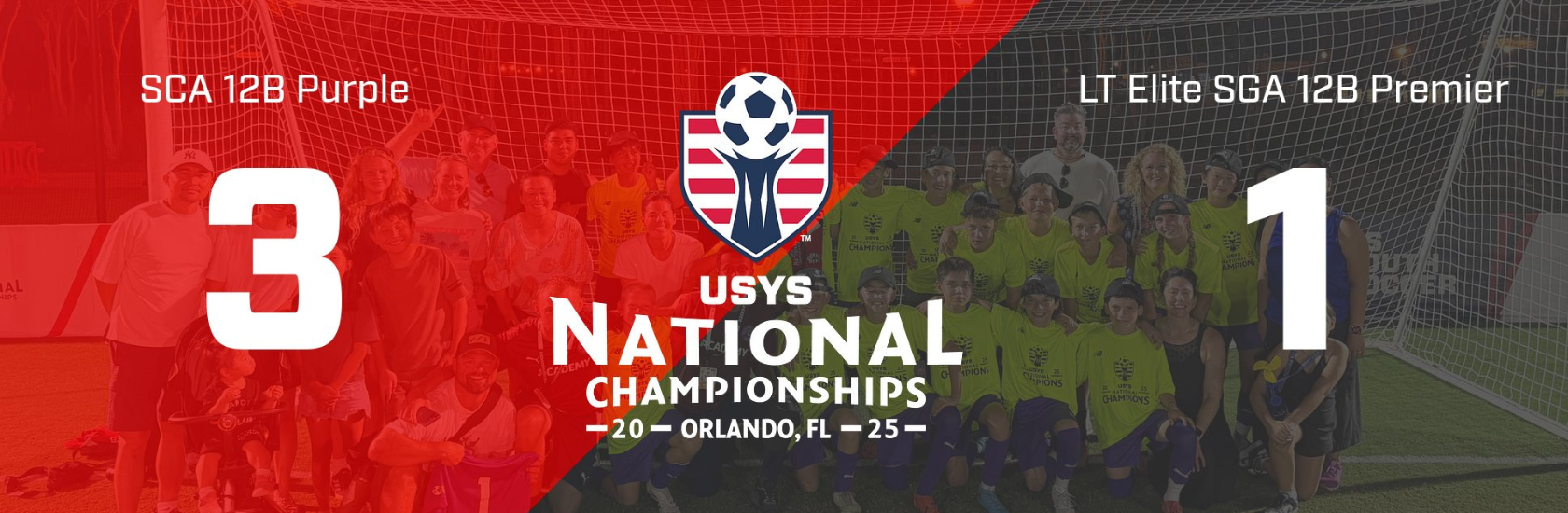
Soccer Chance Academy 2012 Boys Purple Crowned 2025 USYS National Champions

History was made once again in Florida as Soccer Chance Academy’s 2012 Boys Purple team captured the 2025 USYS National Championship in the Boys U13 division – becoming just the third Oregon team ever to win this prestigious title (FC Portland Academy BU18 in 1994 and Eastside United FC 91 Liverpool BU18 in 2010).

After finishing as champions at the Far West Regional Championships in Boise, SCA 12B received an automatic bid to Nationals – and made the most of the opportunity.

With a win, a draw, and a loss in group play, SCA secured a spot in the final, where they faced a familiar opponent: LT Elite SGA 12B Premier (TX-S) – the same team that handed them a tough 4-0 loss on opening day.
But the rematch told a different story. SCA struck early with a first-half goal and carried that momentum into the second half, netting two more to take a commanding 3-0 lead. A late goal from Texas made it 3-1, but the result was never in doubt. With the final whistle, SCA became the first Oregon team in 15 years to win a USYS National Championship – and etched their names into the history books.

This is just the fourth national title ever won by an Oregon team across both the Presidents Cup and National Championship Series – and the second one this year, following CFC 2008 Black’s triumph at the 2025 USYS National Presidents Cup.

Congratulations to the players, coaches, families, and the entire SCA community. You’ve made Oregon proud and cemented your legacy on the national stage.

Finding Talent Where It’s Least Expected: Why Oregon Youth Soccer is Committed to Remote Clubs and Rural Players (too!)

July 18, 2025 by sdate

In the world of youth soccer, buzzwords like “elite,” “platform leagues,” and “national exposure” tend to dominate the conversation. The focus gravitates toward densely populated urban hubs, pristine turf fields, and glossy showcase events. But here in Oregon, the Oregon Youth Soccer Association (OYSA) is rooted in something far more expansive and, frankly, more meaningful: access and opportunity for every child, no matter their zip code.

Our commitment to the players and clubs in Oregon’s most remote and rural communities isn’t just about checking a box—it’s about fulfilling our purpose. Because the game doesn’t belong to Portland, Salem, Eugene, or Bend alone. It belongs to Burns. To La Grande. To Klamath Falls, Brookings, and John Day. It belongs to every kid with a ball, a patch of grass, and a dream.

The Mission: Opportunity Without Geography as a Barrier

OYSA’s mission is to make soccer accessible to all young Oregonians, and that includes the families living hours from the nearest “platform league” club or professional training facility. While the logistics may be more complicated, and the spotlight a little dimmer, the potential for growth—both personal and athletic—is just as bright.

We often talk about soccer as a teacher of life skills: resilience, teamwork, leadership, grit. Nowhere are these lessons more profound than in small-town soccer. When a kid in Enterprise wakes up before sunrise to drive three hours to attend an ODP (Olympic Development Program) training, they’re not just chasing a ball—they’re building discipline and commitment in a way no coaching manual can replicate.

And yet, these players are often overlooked simply because of where they live.

That’s where OYSA comes in. We see them. We find them. We invest in them.

Yes, We Support Big Clubs Too

Of course, a large portion of our time and resources is dedicated to supporting the many thriving clubs in Oregon’s urban centers—and that’s how it should be. These clubs play a critical role in our ecosystem, developing thousands of players, employing full-time coaches, and competing at the highest levels regionally and nationally. We’re proud of the work we do alongside these clubs.

But it’s not an either/or proposition. We can support elite player pathways in Portland and simultaneously build strong programs in Prineville. We can help urban clubs navigate national league play while also ensuring rural clubs have fields to play on, referees to guide their matches, and access to coach education. Both matter. Both contribute to the health of the game. And both are part of what makes Oregon’s soccer community unique.

The Myth of the “Only Way” Up

One of the most frustrating narratives in American youth soccer is that if you’re not in a platform league, you’re not going anywhere. That simply isn’t true—and we have the stories to prove it.

Take Matt Turner, the USMNT goalkeeper who didn’t even start playing competitive soccer until his teens. Or DeJuan Jones, now a standout in MLS and the national team picture, who was overlooked by most major development academies. These players didn’t follow the typical platform league script. Instead, they were developed in local environments, supported by committed coaches and community clubs, and driven by an internal fire that didn’t require a badge to ignite.

The truth is, great players can—and do—come from unexpected places. And if we only look in the usual places, we miss them. Worse, we send a message that unless you live in the right neighborhood or can afford the right club, you don’t belong.

OYSA is rewriting that message.

Building the Bridge

So, what does supporting rural and remote clubs actually look like?

It starts with intentionality. We’ve made it a priority to:

  • Send staff and scouts into small communities. Whether it’s talent identification for ODP or coach education workshops, we go to them, not the other way around.
  • Invest in technology and hybrid training access. Through tools like video analysis, remote coaching support, and scheduled regional events, we help kids get development touches even when geography presents challenges.
  • Create league pathways that don’t require daily travel or relocation. We’ve partnered with regional clubs to create interlocking schedules and festival-style competitions that allow kids in rural areas to play meaningful games without sacrificing family, school, or financial stability.

We’ve also looked inward at our own policies. Are our tryout schedules accessible to remote players? Are our registration deadlines and fees structured in a way that respects the realities of rural families? Are we equipping small-town coaches—many of whom are volunteers—with the tools they need to succeed?

These questions matter. They drive our planning, our budgets, and our long-term strategic vision.

More Than Just Soccer

When we support soccer in remote communities, the benefits go well beyond the pitch.

We’re creating community glue. In small towns, the soccer team isn’t just an athletic outlet—it’s a point of pride, a social connector, and often one of the few structured activities available to kids. By keeping these programs alive and competitive, we’re investing in the health and vibrancy of these towns themselves.

We’re also building confidence and leadership. When a kid from a rural community realizes they belong in a state pool, or gets noticed by a college coach, or earns a coaching license, it sends a message that success doesn’t require relocation—it requires access.

And let’s be honest: working with kids from small towns and underserved communities is deeply human work. It reminds us why we got into youth sports in the first place. Not for trophies or social media posts, but for transformations—on the field and in life.

Changing the Culture

I’ll be the first to admit: it’s not always flashy. There’s no viral buzz about a grassroots development clinic in Ontario or a referee training weekend in Coos Bay. But there’s value there. And it’s time we stop treating this work as “extra” or “nice to have.” It’s essential.

Youth soccer in Oregon—and across the U.S.—needs a cultural shift. One that says development doesn’t start with exclusivity, it starts with inclusion. One that values small-town commitment as much as big-city exposure. One that prioritizes character over clout.

OYSA is proud to lead that charge. We believe that a kid in Prineville deserves the same chance to fall in love with the game, to grow as a player, and to dream big as a kid in Beaverton.

And when we cast the net wide—when we show up in places where others don’t bother to look—we inevitably find players who surprise us. More importantly, we build a system that reflects the full diversity, geography, and spirit of our state.

The Work Ahead

There’s more to do. We want to:

  • Expand scholarship and grant programs for rural travel expenses.
  • Build a rural coaching mentor network to increase local quality and reduce burnout.
  • Partner with schools and community centers to create new access points for kids.
  • Push national organizations to recognize and reward non-traditional pathways into the game.

And we’ll do all of this with one central belief: every kid counts.

Final Thoughts: Why It Matters

It’s easy to get caught up in the machinery of modern youth sports—the rankings, the social media clips, the national tournaments. But if that’s all we chase, we miss the bigger picture.

When we support a soccer team in a town of 3,000 people, we might not be developing the next USMNT captain. But we might be keeping a kid in school. We might be giving them their first taste of teamwork. We might be helping a future coach discover their passion. We might be changing a life.

That’s the kind of impact OYSA is here to make. And we’ll continue to go the extra miles—literally—to make sure soccer is a game for all of Oregon.

Even the tiny towns. Especially the tiny towns.

Let me know your thoughts: simon@oregonyouthsoccer.org or call me: 503.957.3523

A Graduation Season Reflection for Soccer Parents

May 27, 2025 by sdate

It’s graduation season, which means it’s also the season of pastel dresses, photo backdrops made of balloons, and those telltale Instagram captions: “She believed she could, so she did.” There’s a celebratory air in the school gymnasiums and backyards of America, but lurking just beneath it—especially among the parents of soccer players—is a different emotion: reckoning.

Let’s be honest. Every soccer parent, at some point, dreams their kid will go all the way. Not just college soccer, but the big time: the national team, Europe, a Nike deal, and that satisfying moment when you run into your high school nemesis at the grocery store and casually drop that your son is “on loan at Dortmund.”

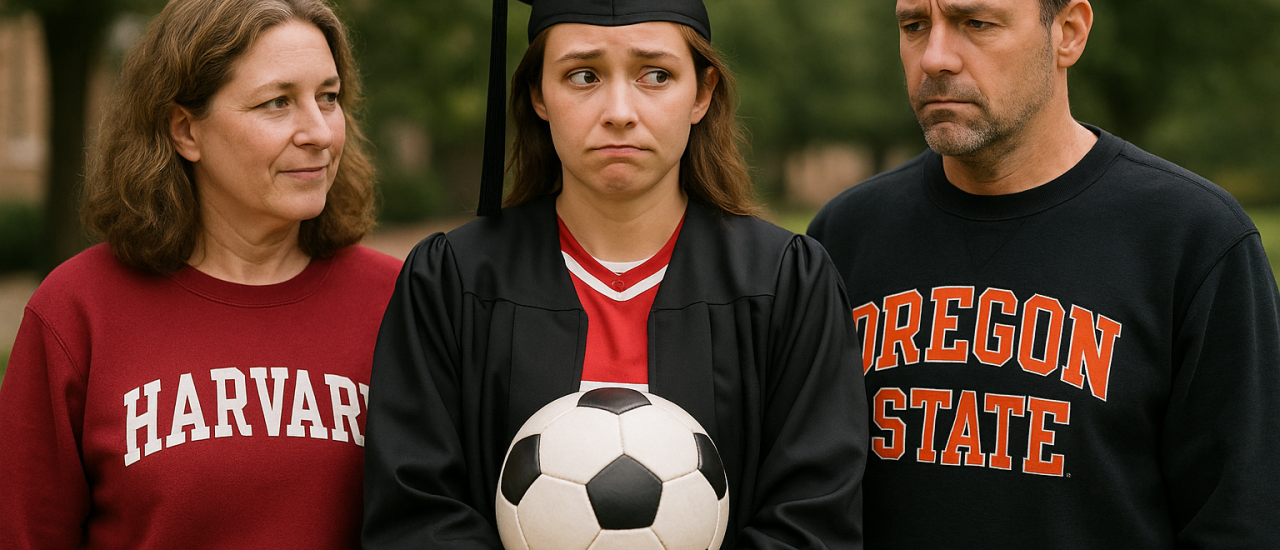
But now it’s graduation, and for many of us, the dream is shifting. Johnny isn’t going to Stanford. He’s going to Oregon State. Or Chico State. Or maybe—gasp—he’s done with soccer altogether.

And that’s okay.

What Soccer Parents Think Development Looks Like

In our heads, “development” has long meant forward progress. It’s linear, measurable, and always trending upward. It looks like this:

  • U9: Starting winger on the club team
  • U11: Academy call-up
  • U13: State ODP
  • U15: ECNL or MLS Next roster spot
  • U17: Scouted by college coaches at showcases
  • U18: Signed to a D1 program
  • U19: Freshman minutes, eyes on pro dreams

But here’s the kicker (no pun intended): kids aren’t stock portfolios. Soccer development isn’t an index fund. It doesn’t always compound annually. Sometimes it stalls, sometimes it plateaus, sometimes it redirects entirely. Sometimes it leads not to Harvard, but to Oregon State—and even then, it might be as a student, not an athlete. And here’s the thing…that’s okay!

So what, then, is “development,” really?

The Real Definition of Development

Development in soccer isn’t a list of accolades. It’s the process of becoming a better player, a better teammate, and a better person. It includes:

  • Learning how to take feedback without crumbling.
  • Sitting on the bench and still cheering for your teammates.
  • Coming back from an injury more determined than ever.
  • Understanding tactics, timing, and decision-making, not just goals and assists.
  • Realizing you don’t want to play in college—and making peace with that.
  • Choosing a college for the right reasons (academic fit, personal happiness), not just the size of the soccer program’s stadium.

And let’s not pretend that every other area of a kid’s life is held to the same high, almost delusional standards we apply to youth sports. No one says, “Well, she only got into Oregon State for engineering. Guess the dream is over.” You’d say, “That’s amazing!”

But in soccer, anything less than D1 often feels like a funeral for potential.

Soccer Isn’t an SAT Score

The irony of this time of year is stark. We celebrate all kinds of achievements: finishing a tough school year, learning how to drive, discovering new interests, even just surviving the teenage years without fully combusting. But when it comes to soccer, if the destination isn’t a marquee name or a full-ride scholarship, the accomplishment is somehow “less.” How many times have I heard an almost ‘apologetic’ tone when a parent says their child will be playing soccer at a D3 college, or a JuCo, almost feeling necessary to explain why it’s ONLY that school…

This is absurd.

Imagine telling your friend, “My son is going to Oregon State for computer science,” and them replying, “Oh. Not Harvard?” You’d rightfully find that offensive. But we do the same thing in soccer all the time:

  • “Oh, he’s just playing club in college, not on the real team?”
  • “She didn’t get recruited? But she had so much potential.”
  • “He’s quitting after high school? That’s such a shame.”

A shame? Really? Since when did playing a sport for over a decade, making lifelong friends, learning discipline, experiencing competition, and building resilience become something to be ashamed of?

How to Cope When Your Kid Doesn’t “Make It”

Here are a few tips for recalibrating your expectations and embracing what your kid did achieve—even if it wasn’t “Harvard-level” soccer:

1. Redefine Success

Ask yourself: Would you rather your child be a benchwarmer at a top D1 school, miserable and burnt out, or a happy, confident student thriving at a smaller school, playing club or intramurals and loving the game? One builds identity; the other builds resentment.

2. Stop Comparing

Comparison is the thief of joy—and the mother of insecurity. Just because the neighbor’s kid committed to UCLA doesn’t mean yours failed. Everyone’s path is different. If your kid found a place that fits them, you won.

3. Celebrate the Journey, Not the Résumé

Your child woke up for 7:00 AM tournaments. Played in 100-degree heat. Dealt with injuries, tough coaches, tryouts, and heartbreaks. That is growth. That is strength. You cheered from the sidelines (sometimes too loudly), drove endless hours, and paid for god-knows-how-many cleats. You didn’t fail. They didn’t fail.

4. Normalize Walking Away

Not every kid wants to play in college. And that’s fine. If they’ve discovered other passions, that’s development, too. Let them pivot. Life isn’t about pleasing your ego—it’s about becoming who you are.

5. Talk to Former Athletes

Find parents of college athletes, especially D1. Many of them will tell you the same thing: It’s a job. It’s exhausting. And often, it comes with tradeoffs—mental health, social life, time, and academic flexibility. For some, it’s amazing. For others, it’s a gilded cage.

6. Keep the Game Alive

Just because competitive soccer ends doesn’t mean the sport has to. One of the most heartwarming stories we’ve heard recently came from a good friend whose son didn’t get a lot of minutes in high school. He was never a starter, rarely in the spotlight—but he loved the game. And now, in college, he’s playing intramurals, having a blast, and still finding joy in soccer on his own terms. That, in many ways, is the best indicator of real development: he didn’t need a roster spot or a coach’s validation to keep playing. He plays because he loves it.

Adult rec leagues, pickup games, coaching younger players, or even becoming a referee—all of these are meaningful ways to stay involved. The love of the game doesn’t have to end with high school. When a child keeps soccer in their life by choice—not pressure—that’s a powerful, lasting success.

A Final Thought: It’s Not About You

It’s natural for parents to feel deeply connected to their child’s journey—especially when it’s something you’ve invested time, energy, and emotion into for years. Soccer has likely become a shared experience: early mornings, long drives, hotel rooms, sideline snacks, victories, and heartbreaks. So when that chapter comes to a close, or doesn’t turn out the way you once imagined, it can stir up all kinds of feelings.

But it’s important to remember that this journey ultimately belongs to your child. Their path, their pace, and their passions may look different from what you once hoped—but that doesn’t make it any less meaningful or successful. Your role isn’t to steer the outcome, but to support the person they’re becoming through it all.

When we let go of the idea that athletic success validates our parenting or fulfills something in us, we’re better able to appreciate the real growth that’s taken place. Your child may not have ended up where you once envisioned—but they’ve grown, stretched, endured, and discovered who they are. That’s the real win.

P.S.

I went to Oregon State, and played soccer there back in the 90’s. Oregon State has a great soccer program (College Cup in 2023). And a beautiful campus here in Corvallis. And—just like Harvard—coffee shops with overpriced lattes. Come visit anytime. Go Beavs!

USYS Oregon
Privacy Policy
This website is powered by SportsEngine's Sports Relationship Management (SRM) software, and is owned and subject to the USYS Oregon privacy policy.
Powered by SportsEngine